

Vincent Bevins recently wrote a great essay re-evaluating the effects of the Musk reign over the platform formerly known as Twitter. In it, he argues the “vibe shift” — that weird moment right after Trump won when the media seemed to think his program and ideas were authentically popular — was largely a consequence of X being re-engineered to the benefit of chuds.
It wouldn’t be the first, last, or only time the engineering of a social media platform has helped change the way people think. But what I’m curious about is exactly by what levers, rule-changes, and incentive-swapping such shifts happen.
Bevins writes,
…the “vibe shift” was the unconscious cognitive effect of hanging out on Twitter after Musk’s acquisition. It was experienced, and only needed to be experienced, in the minds of the US American media class. One of the main skills required of contemporary journalists is the ability to detect which way the wind is blowing, to carefully trace the hidden boundaries of discourse…. and where did New York writers and podcasters spend all their time, and how were they learning about the world? How is it not going to affect the ideological compass of a careerist class when the social hierarchy changes on the screen we stare at nine hours a day?
I mostly buy his argument. The media class was not convinced to like Trump (which would have been impossible) but it was convinced to believe other people liked Trump more than they really did, because the picture of “other people” they were looking at “nine hours a day” was drawn by Musk.
At the very least, Musk’s takeover shifted the discourse wars to a battlefield of Musk’s choosing. At the very most, it helped to muffle early dissent against the administration by distorting the ways it would be reported on. How did this happen?
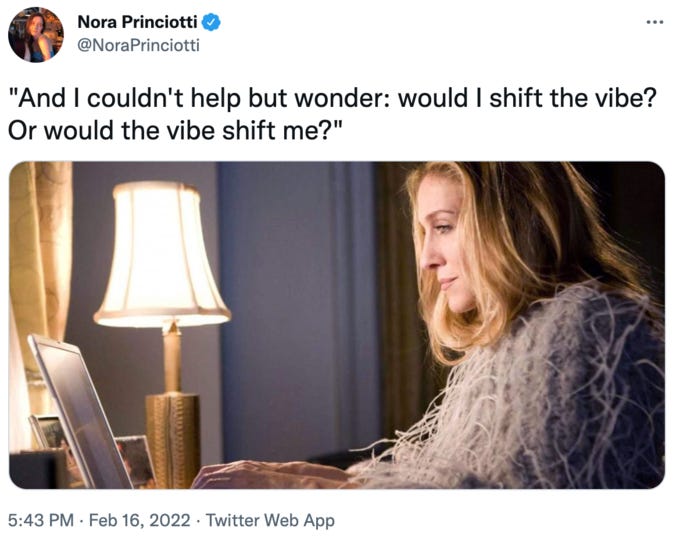
It seems Musk tweaked the algorithm to amplify his friends. He also instituted blue checkmarks, prioritizing the speech of paying customers. He alienated groups of users leading them to leave for other platforms. He actively encouraged racists. Perhaps most significant was his neglect — the platform went to seed, problems weren’t solved, search stopped working as it should, and content moderation essentially stopped happening — or if it did, it increasingly took the side of the trolls. Twitter used to offer what felt like a view of the internet overall. You could start your day needing to write three quick articles for SEO (as I had to for a long while) and know you would find relevant topics by poking around on Twitter long enough. X is more opaque. The trends no longer make sense and the ads are pervy. Beyond people making crude comments about women in reposted TikToks (the most famous being the brouhaha over “Gen Z Boss In A Mini”) the site also doesn’t seem very connected to other parts of the internet.

But it wasn’t all Elon’s fault. The media class continued to read X like a thermometer offering data about the climate of opinion when it was actually a probe taking the rectal temperature of the internet’s loneliest men. Some of it was because many had grown dependent on Twitter as a tool to do their jobs in an era when their work was getting ever-more frantic (layoffs, stress, 24/7 internet news cycle). Some of it was because they were kinda racist themselves. Some of it was because they weren’t very smart. But they should’ve all known and done better.
Economist John Kenneth Galbraith coined the term “the conventional wisdom” in its common usage in the 1950s to describe the kinds of ideas which in polite society are never treated as ideas at all, but as assumptions of fact. The conventional wisdom feels natural and normal — it is the assumed starting-place of the conversation, the implied position of the normal rational observer. For example, the conventional wisdom today holds that people hate data centers. A year ago, people also hated data centers — but the conventional wisdom had not yet caught up to that reality.

If the conventional wisdom is a temperature probe, the reading changes more because people forcibly move it somewhere else than because the weather conditions have altered. Often, intellectual debates are less about convincing somebody on the fence to think your way, and more about shifting the conventional wisdom and the way we understand the position of the fence itself.
Elon found a new way of shifting the probe. Or you could call it a new flavor of an old way — he leveraged a bunch of money to take over the discourse, like Hearst or the Koch brothers before him. But the mechanism was through modifying the operation of a social media platform.
This reminds me of Marcus Bösch’s recent work about memes and AI slop, which I admire a lot. In a recent post, Boomer Realism, he talks of a way of thinking about memes which Daniël de Zeeuw and Sal Hagen in conversation with New Models described as following an “operational” logic rather than a “representational” logic. Bösch writes,
Representational analysis asks what a meme means. But meaning is no longer the primary mode of operation. The White House is not posting memes because they have something to say. They are posting memes to produce alignment, normalization, and the low hum of ambient recognition that precedes any conscious evaluation.
Bösch’s concept of “postdigital propaganda” also touches on this, which he defines this way:
Propaganda is no longer primarily about messages, lies, or even persuasion. It’s about the conditions under which things become visible, feel right, and get endlessly repeated.
It’s about shifting the probe, changing the way people orient themselves in a social landscape. People don’t become trad wives, or Antifa, or whatever, because they see one post, but because they spend time in a feed where these things are first present, then normal, then something you have to take a side on, and then something that becomes a part of your identity.
This is exactly what Elon did when he took over Twitter and filled it with content from Islamophobes and people who think a woman’s place is in the kitchen. Everybody, including those who didn’t believe that stuff, started spending time in a world where, as Bevins writes, we “know far more about reactionary culture than… in 2021. I am familiar with a wide range of flavors of racism now, and I understand all kinds of racist posts at a basic grammatical level.” X got the liberal commentariat speaking according to its grammar.
I can’t give up on representation entirely. Perhaps just because I’m sentimental, but I also think there’s a real reason. Walk with me here — take the metaphor of grammar Bevins uses and extend it: Platforms may have a large hand in determining the grammars people speak by, but people still make their own sentences. An algorithm may determine the conditions of an utterance’s felicity, but people still have agency.
The question I’m asking here is about a line of thinking which I, Bösch, and many others seem to have arrived at — the sense that what matters is the structure of social media platforms, that this structure is up for negotiation and manipulation, and that content is effective primarily by doing something to this structure rather than doing something to an individual viewer.
I see the explanatory power of this line of thinking, but am also leery of how much I have embraced it. The question is, in a way, another version of what people are always asking in media theory, the debate over whether, a Marshall McLuhan said, “the medium is the message.” What Elon Musk did was change the medium that was Twitter (the structure) and as a result we saw a shift in the message (content) of what people said there. But I’m not as willing as a hardcore McLuhanite would be to abandon the notion that the message matters — and in this example, the message also changed the medium because Elon Musk was moved by posts to change the way posting worked.
What I worry is, if you over-emphasize the medium, you end up with a rhetoric of volume rather than of value. The process of content transmission and audience persuasion here is essentially hydraulic — a series of flows, back and forth, where what matters is relative densities of “bad content” in particular parts of the system and the velocity of its spread. Platforms can make “fetch” happen by giving everyone around you money to say the word “fetch” where you can hear it. And in X’s case, “fetch” was “you should hate Muslims.”
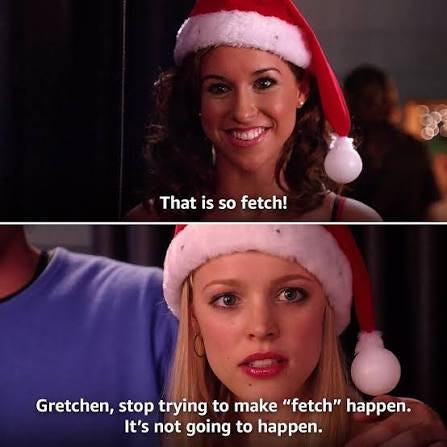
But I don’t think platforms can make just any “fetch” happen. It has to be something that matters to people. Psy-ops fail more often than they succeed, and the ways that makers of memes craft their posts have a lot to do with what goes viral. While much of the internet is aimed at algorithms first and people second now (like I argued in cuck internet theory), it still needs somebody in the cuck chair to catalyze the reaction.
The real last redoubt of representation might be the user themselves. Memes may circulate because of what they do operationally — I think here of the sensonarrative power of Tung Tung Tung Sahur, and the way he turned into a way of tracking the interplay between online and offline worlds — but users circulate according to what they want their circulation to mean. The user takes the tools offered by social media and uses them to create a representation of themselves, or at least of a desired state of mind. An artist may draw a self portrait with a pencil on a piece of paper; a scroller draws it with engagement on an invisible algorithmic profile. The little worlds people make on social media out of memes, subcultural affinities, and conspiracy theories are creative works. The person people are most often talking to and about on the internet is themself.
By this way of thinking, the post’s most important authors are not whoever first made it, but the thousands of people who liked it, pushed it, and by far outnumber its creators. The question to ask of the White House’s memes is less “what did they mean by that?” than “what do people get out of that?” The question of what it “does” within the system, platform, and algorithm is also important, but what memes represent are the people who use them.
Maybe?
Trevor Paglen and Jernej Markelj are great for reading more about the operational vs representational distinction!!
I'm definitely in the camp of believing both exist simultaneously, and it's not a contradiction to believe this
I think it is important to tie in your earlier works as you did here. The cuck internet theory especially. The cuck internet theory especially. To elaborate upon and tie into new elements of the discourse.
All that said, great work.
What I enjoy most is your referencing other authors whose ideas resonate with yours.