
notes on gooning
ten ways of looking at a gooncave
Gooning is a weird internet subculture
A recent piece in Harper’s by Daniel Kolitz titled “The Goon Squad” will likely stand as an important artifact in the historical record. If you have not heard it defined, gooning is a subculture dedicated to a hypnotic form of masturbation, usually oriented around several screens of online pornography, hours-long sessions, and ample discussion in chatrooms between practitioners. Kolitz goes deep into the subculture, interviewing practitioners and charting the viral rise of gooning.
But for a phenomenon this complex, and this symptomatic of our contemporary moment’s various pathologies, there are always multiple ways of seeing it. I wanted to check out a few of those perspectives here.
“Gooning” is a broader cultural phenomenon
I wrote the Know Your Meme explainer on gooning in 2024, and can tell you that the subculture seems to have coalesced on Reddit and Discord shortly before the pandemic, flourishing into broader public awareness around 2023 and 2024.
When we talk about “gooning,” it’s necessary to make a distinction between two separate but related things: first, the specific subculture of fetishists that Kolitz’s piece is about, and second, the broader internet’s use of the tropes, terms, and memes associated with gooners — that is, the ironic deployment of the idea of “gooning” by folks who aren’t engaged in this particular practice at all, and the fixation on “the gooner” as a stock character of the contemporary internet.
We’re all gooners deep down
Kolitz draws this connection between the specific practice of gooning and the broader cultural resonance of the idea of gooning in one of the piece’s most interesting sections:
What are these gooners actually doing? Wasting hours each day consuming short-form video content. Chasing intensities of sensation across platforms. Parasocially fixating on microcelebrities who want their money. Broadcasting their love for those microcelebrities in public forums. Conducting bizarre self-experiments because someone on the internet told them to. In general, abjuring connective, other-directed pleasures for the comfort of staring at screens alone. Does any of this sound familiar? Do you maybe know some folks who get up to stuff like this? It’s true that gooners are masturbating while they engage in these behaviors. You could say that only makes them more honest.
In this telling, gooning is the logical endpoint of current cultural habits around technology. We have normalized choosing the screen over other humans.
Gooning is the death drive
More than sexual perversion, the gooner’s crime is screenic perversion — a pathological overuse of the technology which all of us are overusing. The figure of the gooner is so compelling because it is who we fear we may become. But a little piece of us also wishes we could become him, totally abandoned to anti-social screen obsession.
Psychoanalytically, you might say there is a bit of the death drive in gooning. Abandoned to a state of passive, unselfconscious being with all worries visually, genitally, and auditorily stimulated out of his awareness, the gooner is more like a houseplant than a person. The UberEats order lands on the doorstep, the video lands on the feed. In goonlife, there is never a place you need to be tomorrow morning and never anybody you might disappoint.
Gooners are hermits
In last month’s piece “the gooner and the caveman,” Etymology Nerd pairs the gooner with a figure that seems to be his exact opposite: the Neo-Luddite. “The gooner seeks to dissolve the self in an online fantasy,” Adam Aleksic writes, “the caveman seeks to dissolve the self in an offline fantasy.”
Whether you retreat to a “gooncave” walled with monitors or to the “impossible primitivistic utopia” of our caveman ancestors (which seems to be the goal of more radical Neo-Luddites) what you are doing is rejecting fellowship with other humans as it currently exists. You are dropping out because the world of others has proven unhealthful, hostile, or wrong in some way. The gooner is a rebel without a cause here, and his rejection of the rest of us carries a charge.
Gooning is a moral blight
The immediate terrain any discussion of gooning falls back on is moralistic. Max Read recently diagnosed a tendency of “platform temperance,” a cultural current in which screens are seen as a kind of drug, a sin that we should regulate. He compares this strain of tech skepticism to the anti-alcohol Temperance movement of the late nineteenth and early twentieth centuries.
Temperance was rooted in observation of the destructive effects of alcohol on people. Those effects were strongly associated with the broader destruction of industrialization and empire. Alcohol was part of what made the slums of cities so dismal, what made the lives of women trapped in bad marriages so difficult. Comorbid with industrial exploitation and colonial violence, mass alcoholism shattered social structures everywhere from reservations on America’s frontier to factory towns in the north of England. Calls to restrict booze were not experienced as a separate issue from the emancipation of women and the improvement of conditions for the working class, but as part of a broader progressive project.
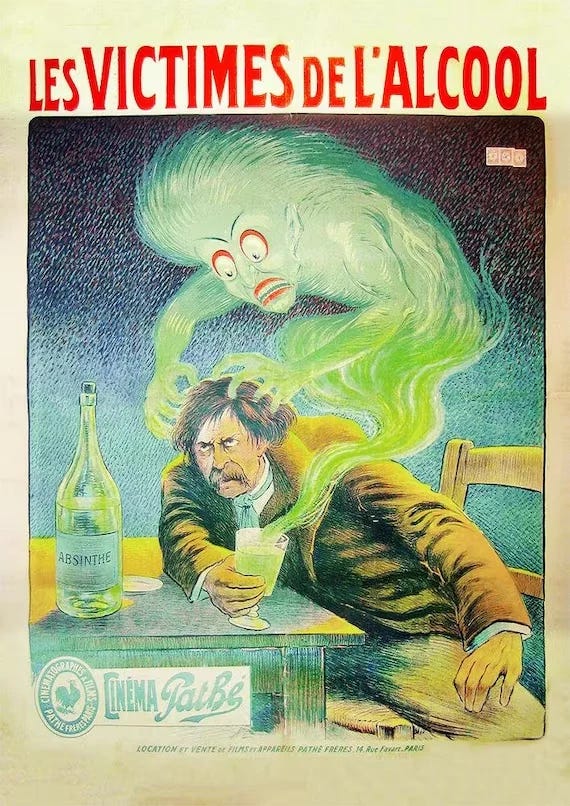
The most-vilified form of alcohol around the turn of the last century was absinthe. Its contemporary reputation as particularly hallucinogenic, addictive, and insane in large part persists due to branding from that era.
Gooning is to screen use in 2025 what absinthe was to alcohol in 1895. The gooner represents the pinnacle of the phone’s sins, the bleeding edge of technology’s threat to social cohesion. Moralizers of all stripes come forward to call out gooning, saying these young men should just go to a bar and, as financier Bill Ackman recently recommended, ask girls “may I meet you?”
Gooning is a structural problem
On an anecdotal individual level, the gooners are people making bad choices and they should take the advice of older experts who have achieved respectable middle-class prosperity. But in the aggregate, gooners represent a problem of society making the wrong choices. A progressive fixation on moralizing restraint is about insisting on individual responsibility and choices while evading our capacity for collective choice.
The way to solve the issue is to evolve our institutions and forms of governance to match this new technology and ensure the social order that flows from it operates democratically. The platform temperance people are sympathetic figures and can be allies in this task. They are too scared, too invested, too unimaginative to revolutionize a system they all know is broken — and yet they are too principled to simply do nothing, which is why they fixate on making young men behave better.
Gooning is fascist
Norm Finkelstein, the prominent pro-Palestine historian who became something of a meme for his strange personality, famously unpacked the term “gooning” on a podcast a bit back. My mutual Charles McBryde wrote about it:
“It struck me,” Finkelstein says, “this is exactly the crowd (gooners) that would go over to fascism.”
In context, Finkelstein is not talking about all gooners here, but about gooners writing for The Mars Review of Books, a literary magazine that partners with monarchist writer and Thiel friend Curtis Yarvin.
Yet there is something in the tendency of gooning qua gooning beyond Dimes Square that does feel fascistic. Gooners craft for themselves a gooncave, a lifeworld walled in pornographic videos that depict unrealistic fantasies of sex, power, and violence. Fascism is all about images of sex, power, and violence — and about losers and creeps dressing up as big men.
The gooner’s encounter with these videos happens entirely through a frame they control: the personal computer. The gooner manipulates the bodies of others on an array of screens. The fantasy of gooning is to never feel anything you don’t choose to feel, and the instrument to accomplish that is technology.
Elon Musk is the world’s most famous gooner
The Wall Street Journal, which has consistently published some of the best-sourced work on Musk over the past few years, reports that the world’s richest man is fixated on Ani, the xAI chatbot companion that is dressed provocatively and will strip if users ask it to.

This should surprise nobody. Elon’s fixation on Ani is partially a business calculation, a bet on AI companions. But it’s also personal, like his entire odyssey with Twitter (now rechristened X, the same name his son bears). Elon’s psychic wounds are apparent to anyone on the platform. He plays the world as if it were a video game, throwing his money around like he’s mashing the buttons on an Xbox controller. He is addicted to that game, has hypnotized himself into it, and wants to force everyone else to play it with him.
Gooning is postmodern cyborg sexuality
Finkelstein remarks, “(Gooning) means being transfixed by video porn for 24-48 hours straight… I don’t know if ‘straight’ is the right word there,” and I agree. If you are aroused by Ani, an animated, AI-generated cartoon of a girl, and dirty talk rendered by Grok, is that heterosexuality? Is that any kind of sexuality?
Desire has always been mediated by images, particularly since the arrival of mass media — but gooning seems to swap the last shreds of biology in contemporary sexuality for an even deeper entanglement with machines and the markets that run them. As multiple videos play over multiple screens over multiple hours, the being that the gooner is actually lusting after is the computer itself more than any of the people depicted on it. The gooner braids his own desire and anatomy into the computer’s rhythms, its reasons. The consummation is between user and device. For most of us, that is probably the most important relationship with a non-human other we have developed. The gooners are having sex with their machines.
Granted I knew gay men into it from the late 1990’s, it seems a little “old” at this point.
The foundations of “gooning” were in late 19th century theatres where you could got to see “What the Butler Saw” on I think was a kinescope, you bent over looked in a viewer and turned a crank. These eventually evolved into coin-op booths with super-8 film loops in adult video emporia through the 40’s and 50’a. Those in turn evolved into multi-tape theatres where you could switch between films on dozens of channels on a video screen which then became short form clip surfing online.
In 1990, I was living in a quite strange left-bank commune in Paris, and one of the inhabitants made short-form gay porn video compilations to support his Cointreau habit. All the best gay bars from Amsterdam to Barcelona had his videos playing.
Ahh, the late great Jim Hayes was the proprietor of the Left Bank commune, Jack Moore was the video purveyor. I should write a book about my time in then sane asylum.
I was the book designer and printer for his last works.
https://en.wikipedia.org/wiki/Jim_Haynes
Your work continues to astound me. Please continue to follow this thread. The cyborg piece at the end is *chefs kiss*