
I.
What I felt on my way to guesting on Real Time with Bill Maher, sitting in my fully-reclined HBO-funded Delta One seat and reading the wine menu the flight attendant handed me during pre-boarding, was shame. I knew the people passing my palatial cubicle on their way to Economy would have every moral right to guillotine me should they choose to do so.
I imagine that if you are very rich, such paranoid shame must be a constant companion, which is why the new first class cabins which airlines are advertising now — videos of which my father watches on Facebook Reels and then sends to me — are walled-off, shielded from proletarian eyes (a true K-shaped economy signal, if there ever was one, because it shows real profit now lies in competing for the market that would otherwise fly private rather than to the masses with diminished purchasing power). I believe the force of that fear, more than mere greed, may explain much of their behavior.
That feeling stayed with me as I checked into the fancy hotel where a room service hamburger cost sixty dollars (HBO’s money, so free for me) and tasted terrible. I ate the room service because the only restaurant option in my actual price range was a taco place I had to walk a mile to get to, because Los Angeles, and I’d got in pretty late.
II.
My favorite thing about Los Angeles is the way it looks at night. Sprawl extends over the hills in all directions, many small lights compensating for a lack of stars in the sky. Sitting on the rooftop of your HBO-funded hotel you can turn your head one way and trace those manmade constellations, then turn it another way and watch the cryptid blue of a perfectly stagnant swimming pool. You feel like a bug in the best way possible.
I tried several times to write the paragraph above, because even from a year’s distance the moment of sitting on the rooftop right after I arrived stands out to me. I had brought up a notebook to write out responses to questions I imagined I would be asked on television. I felt happy and industrious as I wrote, since I was doing a job, but then my absorption broke for a moment and I looked around me at the night.
Maybe like me, you have moments where you specifically think to yourself, “this is memorable, this means something,” and you try to feel the prescribed response. But you know a moment is really memorable when it hops past that reflex to editorialize and you are simply present without the little droning voice that always asks what and how much a thing means. And then when you try and write your way back to it, using that little droning voice which is all you’ve really got, you’re frustrated.
I often find myself in that state of crossing out words in a paragraph or sitting in bed (where I film most of my videos) saying the same phrase fifteen times until I feel, as I say it, that my breath follows the thought correctly. I am watching for something to emerge out of the repetitions, but I cannot be conscious of what it will be while I am searching for it. I am taking shots at a goal at which another part of me is the keeper, gradually wearing down my own defenses until something can sneak past, and a voice better than the ones that made each pass can emerge from their aggregate.
I wondered on the rooftop if an entire life might work like paragraphs and videos work. When you hold a maple leaf in your hand, you see the shape of the trunk in the veins that run down the middle, and you see that same shape in the branch that holds the leaves. If a work — whether a paragraph, a video, a vase — is a segment of experienced time revisited continually and distilled over and over, a tablespoon of breath and gesture, thought and force — could it relate to an entire life in that same fractal sense by which a leaf relates to a tree? Or would that be too convenient?
Anyways, I’m a content creator, did you know that?
III.
I told my friend Candice, whose podcast I’d been on that I was in Los Angeles to be a guest on Bill Maher’s program. She informed me I could not go alone to the studio because they might try and “traffic” me. She dropped her other plans to serve as chaperone.
We met on the hotel rooftop the next morning and ate fries which came with a ketchup dipping sauce and also a mayonnaise dipping sauce, the way they do in Europe. I looked at the many rooftops over the hills, which seemed less grand in the daylight. I got the sense Candice Lim, who writes a wonderful Substack, had carefully and competently assessed my mood, realized the kindest thing she could do was get me to stop thinking so much about what I was about to do, and decided to tell a series of highly entertaining stories. I appreciated the sense of genuine decency paired with relentless fun-seeking she had about her, like if a Fitzgerald protagonist was in the body of a girl from Orange County. The swimming pool water swayed with leftover agitation, somebody had just left it, or else there was a wind blowing.
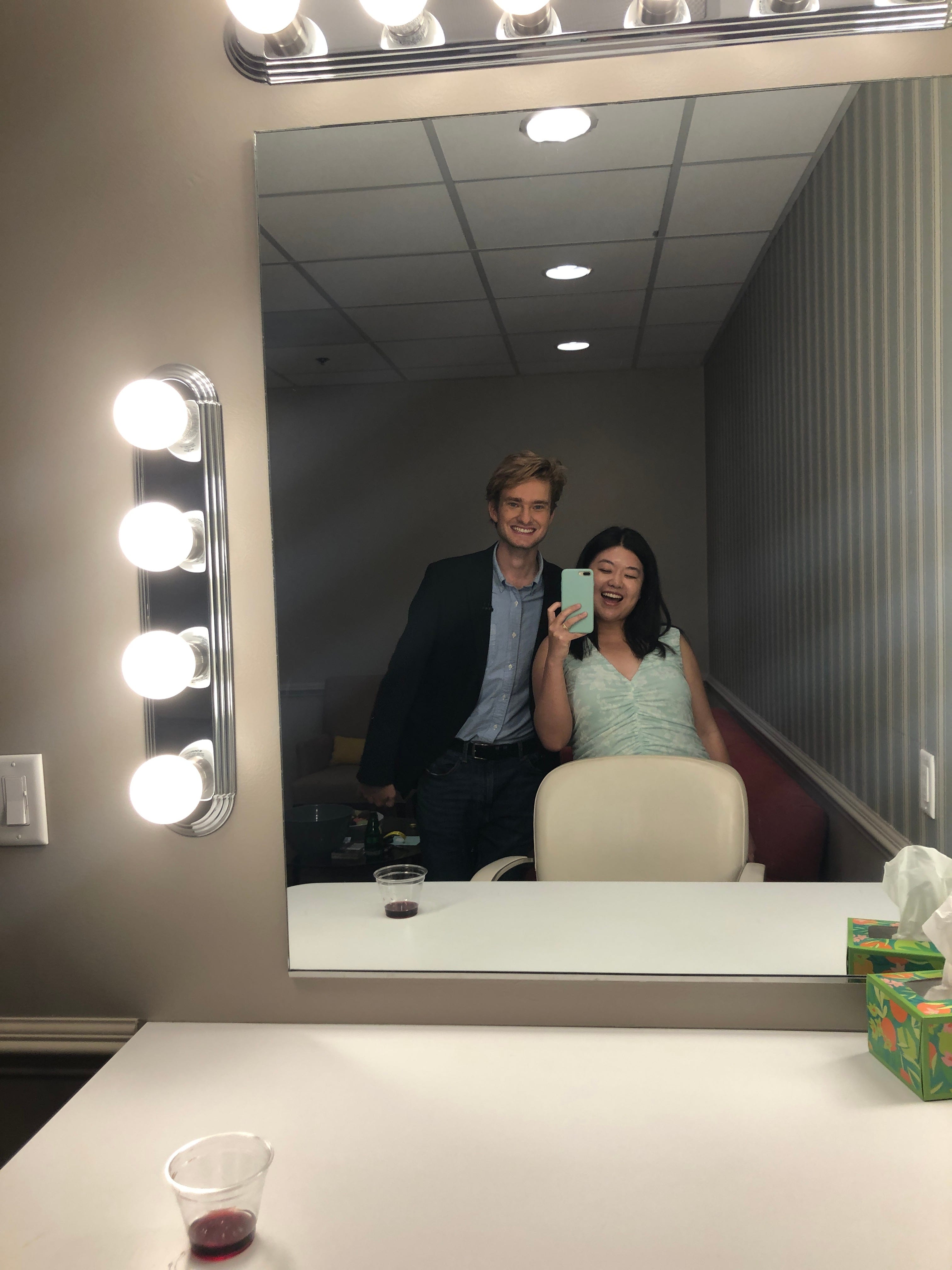
The moments slide past me in remembering. A black car came, and Candice told me how she had to sit on the floor at Hasan Piker’s house as her reporter friend interviewed him. We arrived at the studio lot. I went through hair and make-up, met a variety of people, took an Ibuprofen because my head hurt, became concerned about the way my shirt would look tucked versus untucked, consulted Candice who said not to overthink it, worried I had visible snot in my nostril and blew my nose several times, then worried the constant nose handling made the producers think I’d just gone into the bathroom to do cocaine (I’ve never done cocaine) sanitized my hands a few too many times to compensate, told Candice I worried people thought I was doing cocaine, took a selfie with her, and then found myself told it was now time, shepherded along, and suddenly standing backstage with Candice and the very supportive producer and tech guy, ready to walk out and meet Bill Maher.
Walking out on stage, I felt the instant clarity you have when somebody is injured and you swing into action. There is no excess mental energy to devote to anything but the completion of the task before you. The feeling was oddly peaceful.
He was smaller than I expected him to be, and older. I immediately was able to anchor myself on his gaze. It was a kind of look I recognized from high school theater — that of an onstage scene partner. He was watching me half in the way you watch a human you’re having a conversation with and half in the way you watch a gauge you’re working with. We were here to produce something, and in that limited sense Bill Maher would be my best friend for the next fifteen minutes.
The thing that conquers nerves in an interview is remembering you never have to actually answer a question, you can just yap. The person who gets to steer the conversation is whoever grabs the wheel. Watching back the footage, my answers seem nervous and stumbling. I cut myself some slack because much of this is generational. Maher, like many old guys, doesn’t know much about memes — and like many young guys I have a hard time entering into the mindset of somebody who doesn’t know much about memes. He asked me to interpret memes from the Netflix TV show Adolescence, which I’d never seen — I study real memes, not fictional representations of memes. In response, I re-explained some of what I said in my viral video about Kirk. I had one point I wanted to make, which I’d planned to insert somewhere, which I’d written out on the rooftop — the idea that “the world of the phone offers infinity, while the real world narrows around you.” Once I inserted that I was less nervous.
Then this exchange occurred:
The producer had told me Maher probably didn’t want to talk about the trans stuff with me, so I was at first shocked he brought it up. But he’s always talking about the trans stuff, so I wasn’t all that shocked.
After the fact, people in the subreddit accused me of being “triggered,” and I suppose I was. His lead-in to the question went on so long (perhaps a conscious effort to offer me time to think) that I figured the powerful thing to do would be to go very short. Then he pressed — I bought myself time by asking him to repeat what he had just said, and also tried to get him off whatever rhythm he was on by forcing him to say it again (the thing people most underrate in communication is rhythm — if you can set it, you have the upper hand in the conversation, which is why Charlie Kirk talked so fast).
And then I decided the best way to answer it was tell a joke, gracefully exit because he’s been arguing about trans people on television for as long as I’ve been alive and would definitely win if it came down that. But as the laugh landed, I saw him preparing to pivot and I felt like if I did nothing I’d be letting my friends down, so I followed up with that educator remark, the ridiculous hectoring finger point was totally unconscious. He said “fuck you,” and I immediately went for the reconciliation because I hate conflict.
IV.
From the beginning, I’d told them I did not want to do the panel segment because Congresswoman Nancy Mace, who I find to be certifiably insane, would be one of the other guests (I later glanced her and an aide sitting at the hotel bar at 8 AM, as I made my way back to DC — but that’s getting out of chronological order here). They expressed disappointment but kindly allowed me to skip it.
And so immediately after the interview with Maher, I went to the open bar in the green room and pounded two whisky sours. Candice and I chatted as the nerves poured out of me and a succession of strange Boomers, lingering about the green room, pitched me on various business propositions or personal problems. “My daughter, who’s Gen Z,” one man said to me, “she seems to only want to hang around gay guys. Do you have any insight on that?”
“I have to use the bathroom,” I said. I brushed past him and entered the gender-neutral bathroom and looked in the mirror. I was feeling the two whisky sours. On that trip I drank a great deal because I had a “use it or lose it” attitude towards the free HBO booze. I washed my hands, and exited the bathroom again, back into the very gray crowd.
Other than David Hogg, I must have been the only guest that season under forty years old. If you watch Real Time — or really any TV show these days — this fact is quite striking. Almost everyone regularly on CNN could receive the senior discount at the grocery store. When I was a kid, people on TV were a lot younger — largely because they were the same people as are on TV now, but it was twenty years ago. With the advances of modern medicine and stage make-up, it seems like there are many people who can look about 55 for around thirty years.
The press secretary of Nancy Mace handed me her card — festooned with the mark of Mace’s doomed gubernatorial campaign — and said to contact the office if I ever wanted to collab. She looked profoundly Republican, bottle-blonde with a gold cross necklace. I accepted the card, confused because essentially all Mace has done is propose bathroom bills and I had just done an interview where I was clearly in favor of trans people.
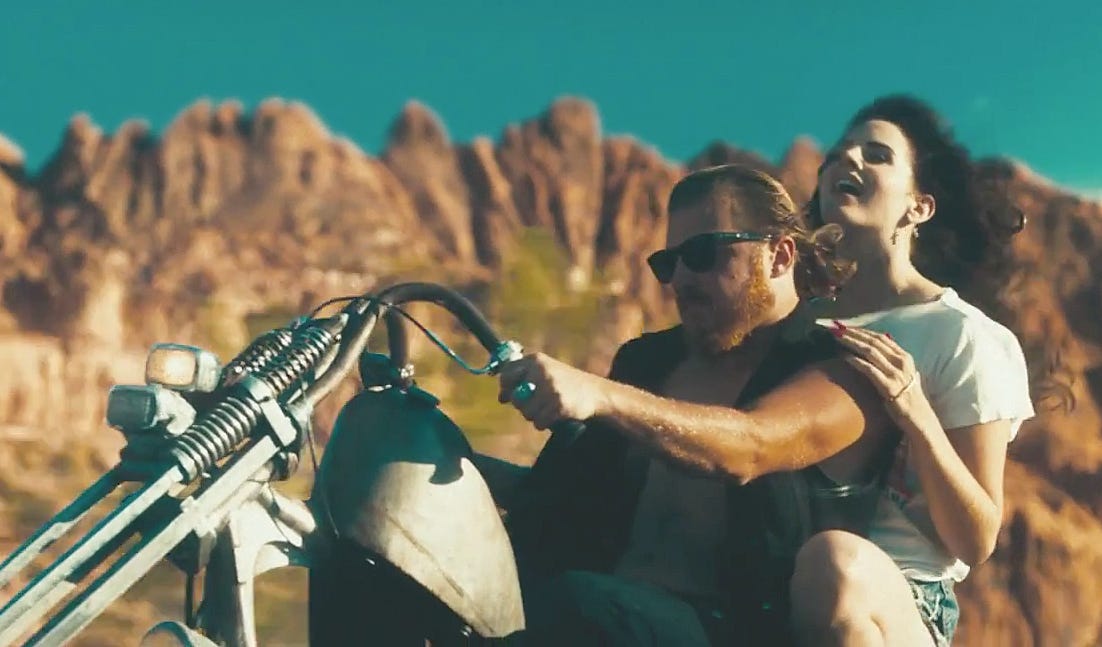
I looked around the room filled with mostly old people mingling. There is a splendid vibe to a happy hour where everybody really knows how to schmooze. People are jovial, gesturing wide, earnestly seeking to interest whoever they’re talking to — it’s not just instrumental networking. They schmooze for the love of the schmooze, which is a dying art. You don’t find many Zoomers who can schmooze like that — too much phone, too much awkwardness, the long tail of Covid isolation. The Boomer’s joie de vivre is the great gift they offer to the young. The mood of this moment is austere, people feel guilty about everything and do party drugs as if they were workout supplements (and vice versa). We cloak ourselves in irony, hit the Penjamin to avoid feeling, drink to get drunk if we drink at all — the Boomer hits the blunt in order to open a panorama of fresh experience, drinks with the spirit of the Mustang stallion loosing itself of the bridle, and taking up the vast prairie’s promise of endless velocity. This is what Lana del Rey loves about them, why she grips the leathered skin of the old bikers in the Ride music video.
You must feel empathy for the Boomer marooned in a world he is not adapted to exist within. It is as if they have been sailing on a boat all their life, a boat which they understood had some problems and was not always pleasant, but it remained afloat. And now that entire boat is sinking, at the same moment they are growing weak and feeble, approaching death. They reach for any kind of floating material they can wrap their hands around. With media types — the people who look into cameras for a living — this clutching is especially desperate because so much of their power came not just from youthful good looks but from an ability to intuit things about the audience, to hop on a trend — to have a read not just on what was going on, but how people would want to feel about it and what you could say to bring them there. Now they have no such orientation.
This is how you end up, as a sixty-something year old man, smoking weed with Hawk Tuah (as she demurely sips a single High Noon and nods politely as you explain evolution). It’s also how you end up listening to me slur my pro forma gratitude, drunk from the whisky sours your hard work paid for, reminding me that yes, in fact, you’ve taught people something about sectarian conflict in Nigeria.
V.
And that, I suppose, is fame and power?
A hired car carried me back to LAX as the sleeping city awoke, stern sunlight filling the black windows of plastic surgery practices and Raisin’ Canes franchises.
I was struck by the sense that the world I was moving in was functionally a kind of parasite on the world out the window which was made of actual leaves, actual dirt, and actual things that had to be loaded, moved, and sold. My disillusionment is itself a cliche. I flicked through my phone, answering texts and DMs from people congratulating me, dazzled at the power trad media can still hold. And as I looked at each name — parents of friends growing up, people I met in college, people I met at work, other creator friends — I thought for a minute about what I knew of that person. If I’d been over at their house, I thought of the room where they must be writing me from — if I hadn’t, I thought of the way their face would look when they laughed, of where we’d met and what I knew of where they were now. I figured there was something so beautiful about the power of television, the internet, to bring together all those different lives I knew along with many I knew not at all (that morning, my email inbox was flooded with praise from educators, death threats, and rambling manifestos). And yet, as a society we’d totally squandered that power, used it to share what was lowest about us rather than what was best.
I wondered if a single work — a television appearance, a video — seen by so many people passing their eyes over it could be refined by that passing and repassing until it could say something better than any one person could. If a moment of experienced time, distilled by broadcast, could relate to the world the way a leaf relates to a tree, and maybe make it better. But who knows if things like that really happen?
A thoughtful reflection on a singular (?) life experience. You've written such a fine essay -- the mix of cultural insights and vulnerable personal emotions resonates.
lolololol fuck maher well done