
Kilroy Was Here
the first meme?
One thing people often ask me is, “what’s the earliest meme?”
The question has no clear answer. Sometimes I’ll say “the line is hazy, but there’s the dancing baby and email copy-chain jokes in the 1990s and so on.” I could also mention fan art around Homestar Runner, gags on message boards and web forums, funny cat photos. But there’s something deflating about those answers, because a meme isn’t just “funny picture popular on the internet.” There’s other stuff going on.
For that reason, the answer I like to give lately is Kilroy Was Here.
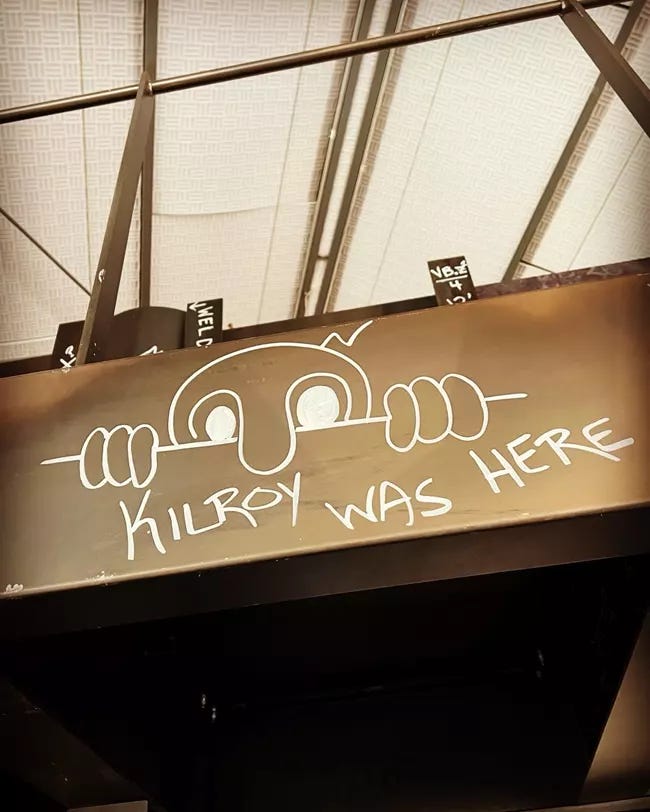
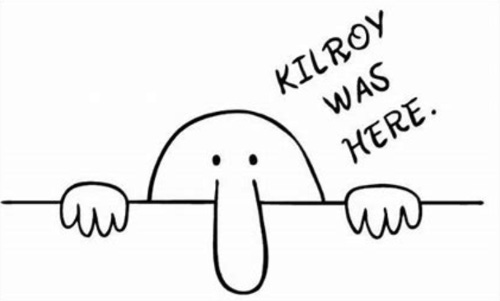
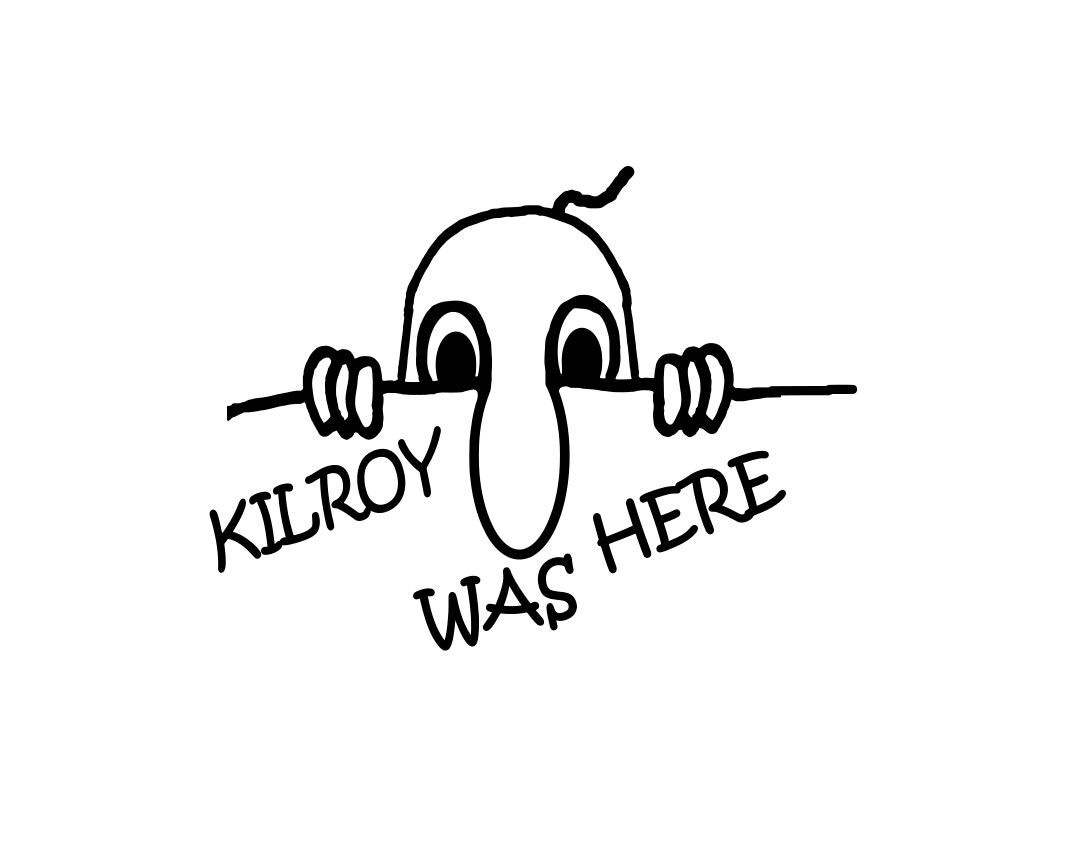
Kilroy was a graffiti character drawn by British and American soldiers on planes, tanks, walls, and essentially any other available surface during the Second World War. Drawn rapidly with a few simple lines, he is bald, big-eyed, and long-nosed, peering at the viewer over a fence he grips with two hands.
The joke was that no matter where you were with your unit — a remote village in Italy, a tarmac in New Guinea — you would find a Kilroy and know he’d already been there. And as soon as you got somewhere, you’d draw a Kilroy for the soldiers coming after you.
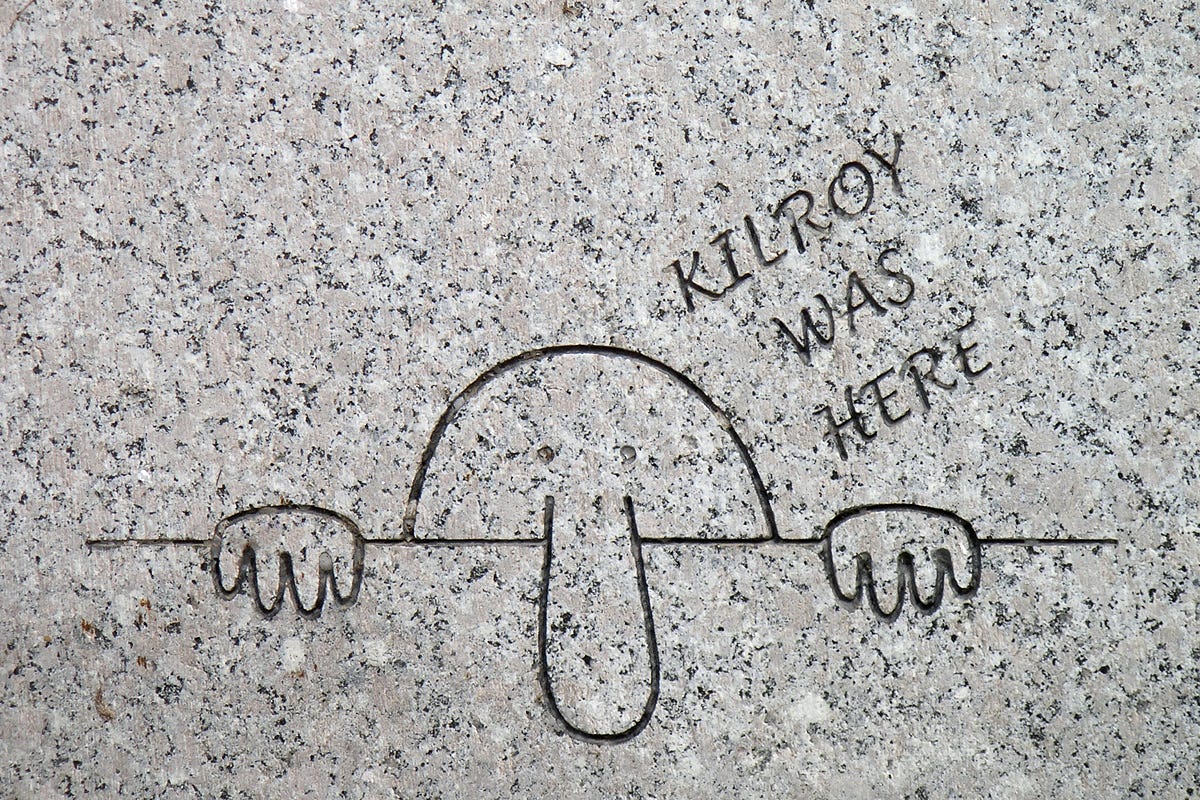
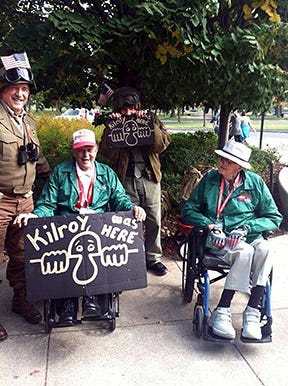
It is hard to overstate how big a deal Kilroy was. They made a 1947 movie about the joke. He is engraved in two places on the World War II Memorial in Washington, DC, officially sanctioned by the government.
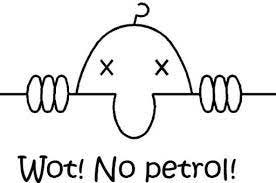
He had names other than Kilroy. Two of them — in an uncanny resonance with contemporary meme culture — were “Chad” and the “The Goon.” Various catchphrases also accompanied him, ranging from the simple “Kilroy was here” to the more complicated British format of “what, no x?” with the x depending on the setting of the graffito.
Kilroys began popping up everywhere. It was said that Hitler thought “Kilroy” must be some secret codeword from American intelligence since it kept appearing on captured equipment. Upon exiting his VIP en-suite restroom at the Potsdam Conference in 1945, Josef Stalin was said to have turned to an aide and asked “who is Kilroy?” And a Kilroy allegedly discovered in the British Parliament asked “what, no questions?”
On the site kilroywashere.org, an early web repository for World War II memories, soldiers remember other particularly insane Kilroy sightings:
A night or two before American forces were set to assault German fortifications on the Rhine River, anticipating heavy casualties, a GI observed "Some crazy SOB crossed the river and painted "Kilroy was here." on the cement wall on the German side of the river!"
Similarly, “on the morning of September 15, 1944, just before the first wave of Marines were to go in” for an assault the island of Palau, a soldier on the deck of a ship testifies:
I spotted something in the rocks [on the shore] and got curious enough to borrow a pair of binoculars from the quartermaster to check it out. When I shouted out, "Kilroy was here!" everybody in the pilothouse thought I was crazy, and it was sometime before anyone would take me seriously. But there it was, about a thousand yards from the first landing beach, at the top of a pile of rocks, was a sign that said, "Kilroy Was Here!" No one had an explanation for how it got there. No American could have done that and no Jap would do it. We were the first in, and no one in the landing party had made it ashore at that time. Someone suggested that it had probably been put there by some Jap who had lived in the States, but I argued that no Jap about to meet his maker would do a thing like that. Three days later I "celebrated" my nineteenth birthday.
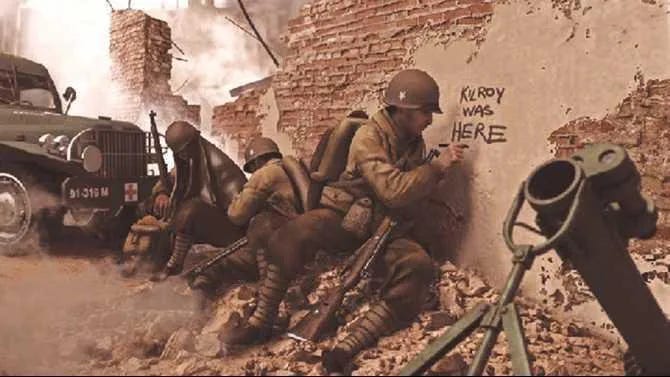
Some things in human nature are eternal. These nineteen-year-old guys from Ohio or wherever were launched by the government into remote violent corners of the world they had literally never heard of and decided the best thing to do in that situation was doodle themselves a little guy to hang out with. Sixty years later, they (or their adult children) were posting about it on an early Internet forum.
Various legends surround Kilroy’s origins. The most commonly-shared was the story of a shipyard inspector named James Kilroy, who in 1946 won a newspaper competition which sought to establish the meme’s origin. Typically, inspectors at the shipyard would approve a finished piece with a chalk mark, but some workers would erase those marks so they could get paid twice for the same piece. Kilroy, in response, started writing out the harder-to-erase phrase “Kilroy Was Here” on parts he approved. In a rush to get ships out, the Navy neglected to paint over these marks. Sailors and soldiers noticed and started replicating them as a joke.
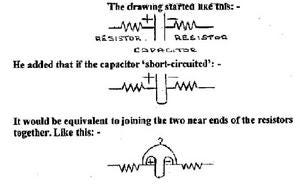
The most common story about the drawing is that he started out as a doodle by British electricians in the service, since he resembles a diagram of a circuit. Accompanied by the verbal gag of “what, no x?” he became a way to complain about wartime rationing — “what no sugar?” or “what no cigarettes?”
The image and the text joined together as British and American forces mingled in North Africa, much as the Tumblr phrase “chungus” joined with the 4chan-popular image of a large Bugs Bunny to spawn “Big Chungus.”
On one level, Kilroy represents the GI himself: a long-nosed fellow (whose nose is vaguely phallic) peering over a fence at the viewer. He represents soldiers as a class, and his placement across an environment that was otherwise scary, foreign, and alienating was comforting. Like the men who drew him, Kilroy was defined by his mobility and by a certain puckish attitude.
Why is it a proto-meme, though?
There have been countless joke cartoons throughout history. What makes Kilroy an interesting candidate for a notable proto-meme are three qualities:
First, as a gesture, Kilroys were phatic communication: they marked that you or someone else had been here, and established a relationship between the absent author and the present viewer. There isn’t necessarily a joke or any content to a Kilroy, just the fact of a presence in a particular space and for particular people. Many internet memes operate by the same logic today.
Second, the combination of difference and repetition. Memes tend to be social trends that involve one collectively-generated piece and one individually-generated piece. With an image-macro meme, everybody shares the picture but then each person attaches their own text. With Kilroy was Here, everybody shared the picture and text, but each person placed it in a new area where they were physically present — and added variations on the style of the drawing according to their taste. The repetition is collective, the difference is individual.
Third, “Kilroy Was Here” is a gag that emerges out of a vast system of communications, logistics, and human mobility. The United States military in World War Two was a massive hive mind that moved men and women around the world. Just as internet memes ride the rails of the internet, Kilroy Was Here rode the rails of that massive, diffuse system. He was posted within that system and circulated through it. He showed up in locations soldiers went to because they were ordered and on material that the system moved from factories to the front-lines. Kilroy made sense because a group of people shared a common experience of that system, and he became kind of a mascot of that experience.
It is that third point in particular which leads me to consider Kilroy a proto-meme. If the James Kilroy shipyard story is taken as the origin point, then Kilroy’s medium is less so walls or chalk than the supply chain and logistical operation itself. Similarly, an internet meme’s medium isn’t so much the .jpeg or text editor but the process of digital circulation itself, which people play around in and inscribe with their own messages. In the same sense that memes are often about the internet (or offer us a vocabulary to think about how it feels to live within it) Kilroy Was Here seems to be about the experience of living ensconced within the globalized system of procurement, transport, and standardization that was the US military in World War Two.
A meme is always testimony and (perhaps) implicit critique of such systems, playing with the sense of living within them much as a painting plays with the experience of seeing stuff, or a song plays with the experience of listening.
The circuit makes some sense but seems a bit contrived. The story I heard was an oscilloscope picture of a radar spectrum. Chad also comes from electronics. Teletypes used punched paper tapes, and a teletype room would be full of the chads punched out of the tape. (Of course the modern Chad switched genders and got pregnant.)
And let us not forget the classic album by the rock group, Styx, titled, Kilroy Was Here, with the hit, Mr. Roboto. (My personal favorite from that album was Heavy Metal Poisoning). It was an attempt by the band to create a rock opera like The Who's Tommy, or Pink Floyd's The Wall. Kilroy Was Here wasn't remotely as good and led to the original band breaking up.