
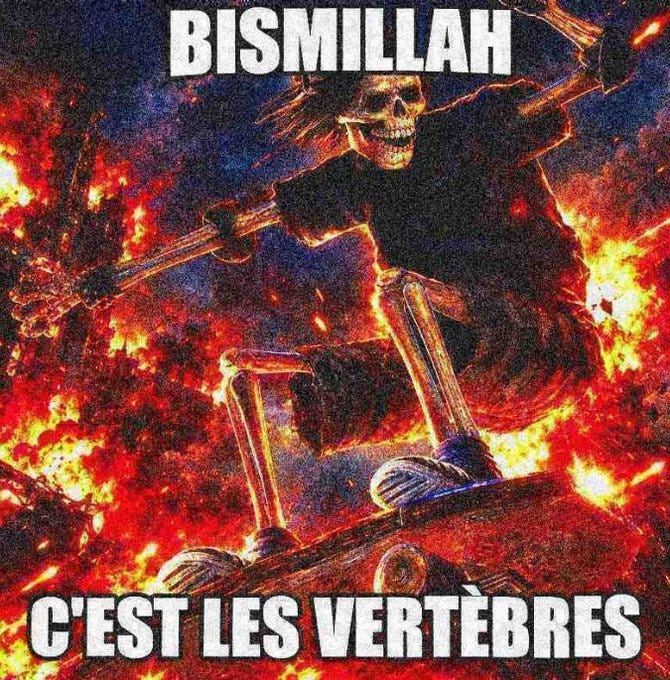
A French policeman squints into Snapchat and types “Bismillah, c’est les ténèbres” (In the name of Allah, it’s the darknesses”) under the username “Mamadou” in a chat with a child. He’s trying to infiltrate the protests happening in high schools by pretending to be a teenager of North African descent. The result is a racist version of the “How do you do, fellow kids?” meme, and the phrase makes no sense whatsoever. Mamadou is also typically a West African name.
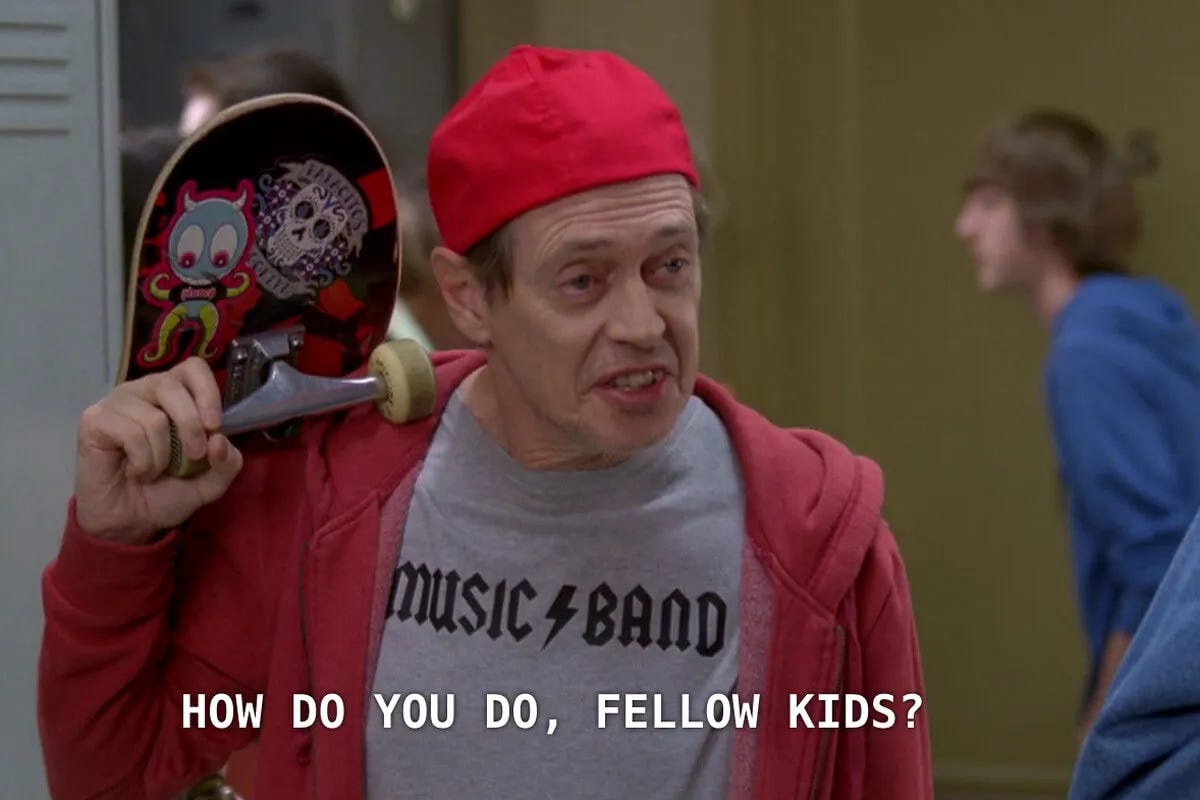
Screenshots of what teens understand to be ridiculous attempts at infiltration of their organizing spaces have turned into one of the best memes on the Francophone internet. In videos, students point out that undercover cops always choose names which sound Arab, mix Arabic and French with incomprehensible or outdated slang, and seem unusually enthusiastic to break things.
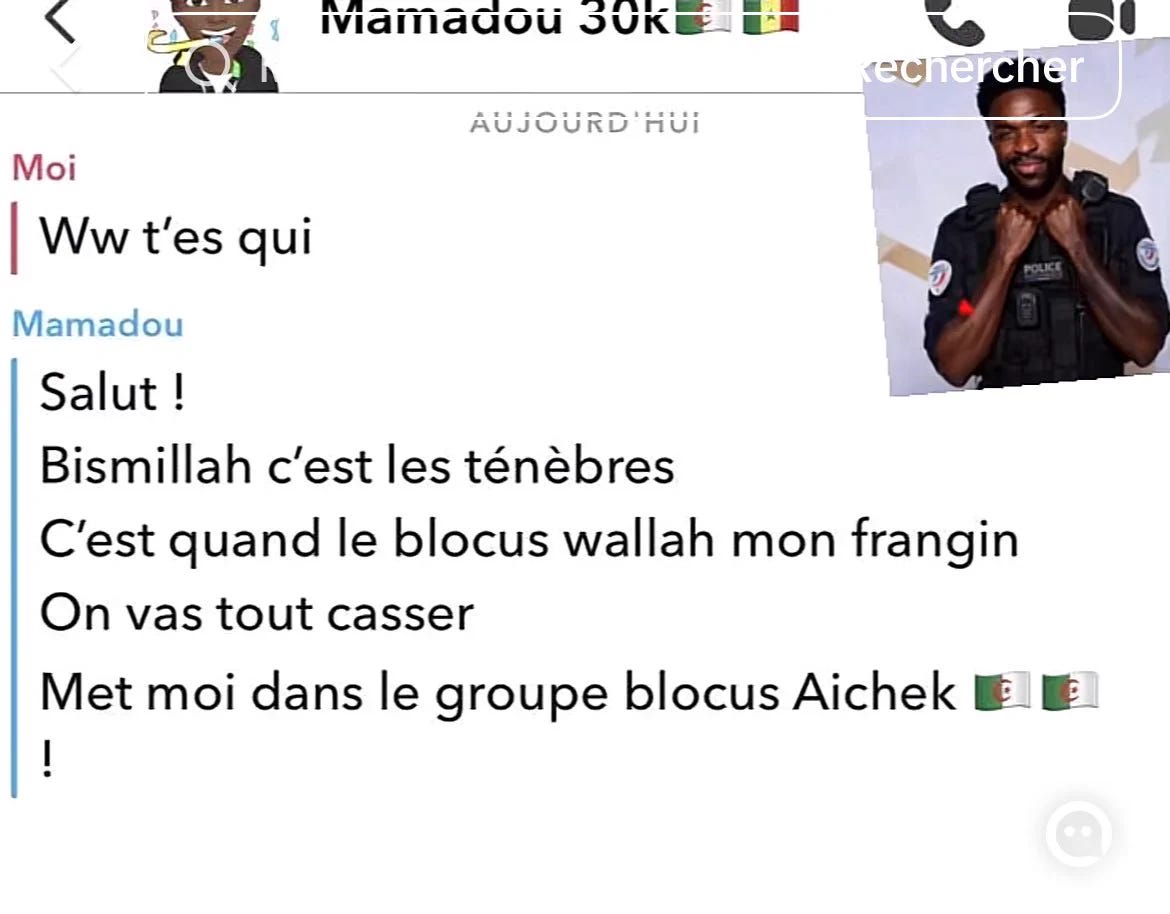
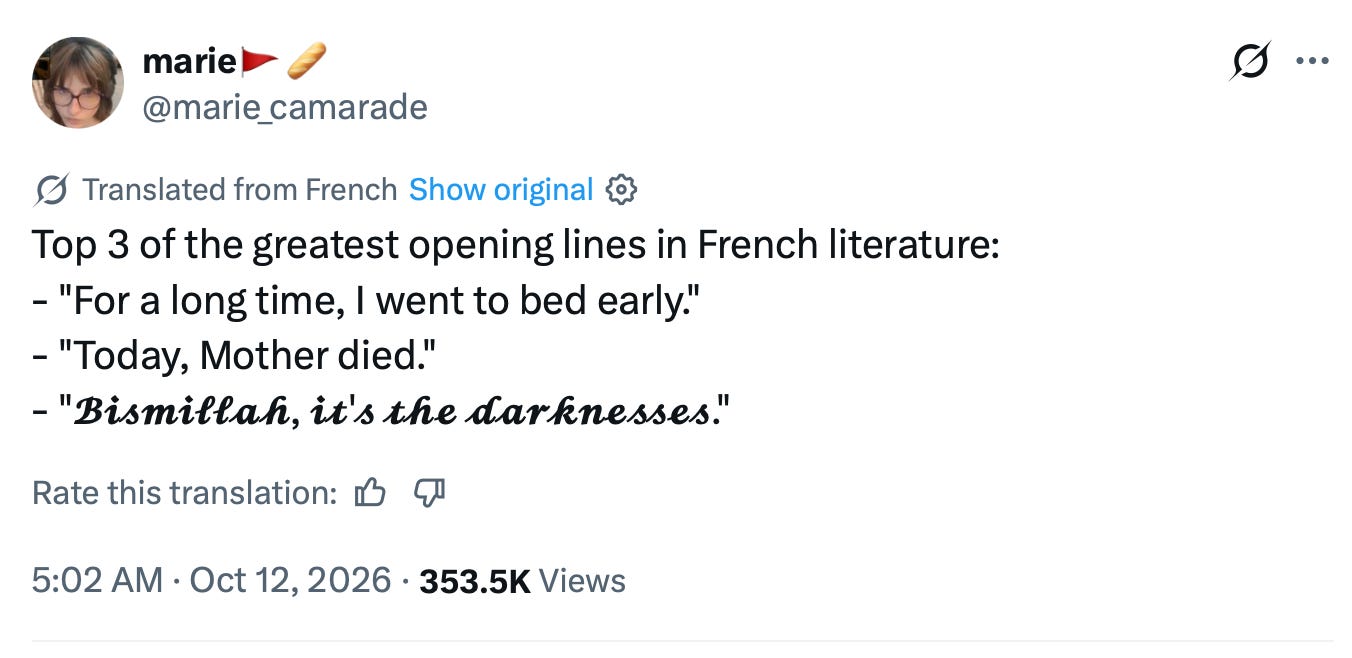
It’s obvious not only that “Mamadou” isn’t real, but that the person writing as him has no idea how actual French sixteen year olds named Mamadou might experience the world, and no interest in learning about their world because he has no respect for them as human beings.1 That’s what the slogan written across signs at protests and comments sections on Instagram now signifies: the police are racist, they know nothing about us, and the state cannot speak to the way our lives really are. And it’s funny.
What the police are doing to teenagers in France today – breaking their teeth, spraying them with hoses, ripping off their hands – is no joke. But what the teens are doing to the police often is, and they aren’t the only ones.
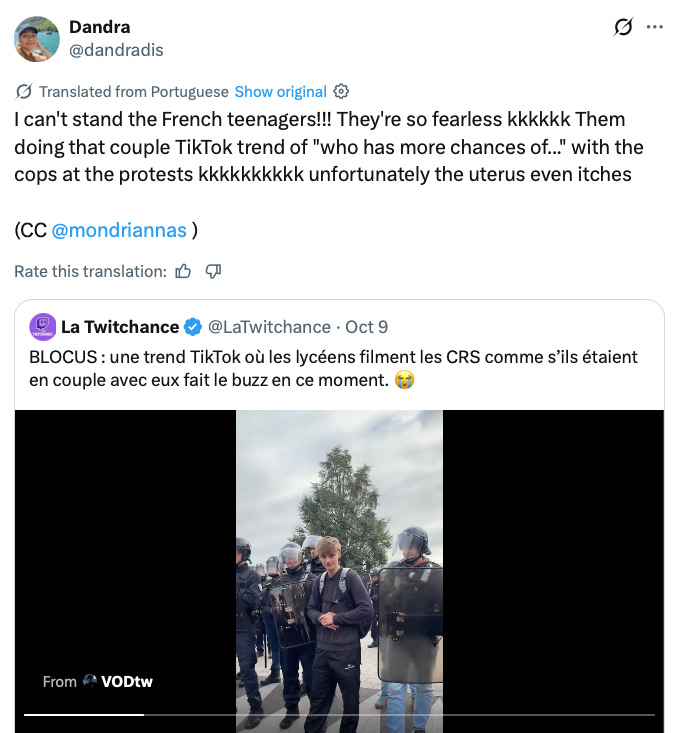
When Nepal broke out in protests, the kids were aura-farming in front of riot shields and performing TikTok audio trends meant for couples (like, “point to the person who’s most likely to take all the covers at night”) with cops — just as they are in France, Albania, and Serbia today, just as they did in Bangladesh.
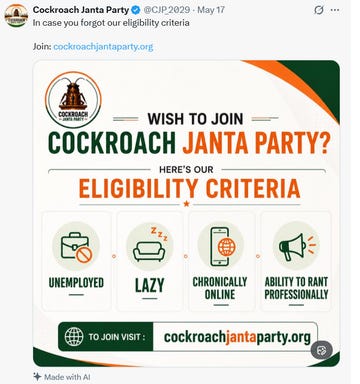
In India, the meme symbol of a cockroach — inspired by the Chief Justice’s derogatory remark comparing young people to the pest – has sparked a protest movement that has rattled the Modi regime.2 Across the world, active street protest movements made up largely of young people confront state violence with jokes.
News footage of these protests differs significantly from what you’re seeing if you follow them on social media. Rather than burning trash cans or buildings, you see orchestras playing the Imperial March from Star Wars as the riot cops roll up. Rather than violence from masked anarchists, you see kids and old folks treating the protest as their third place.

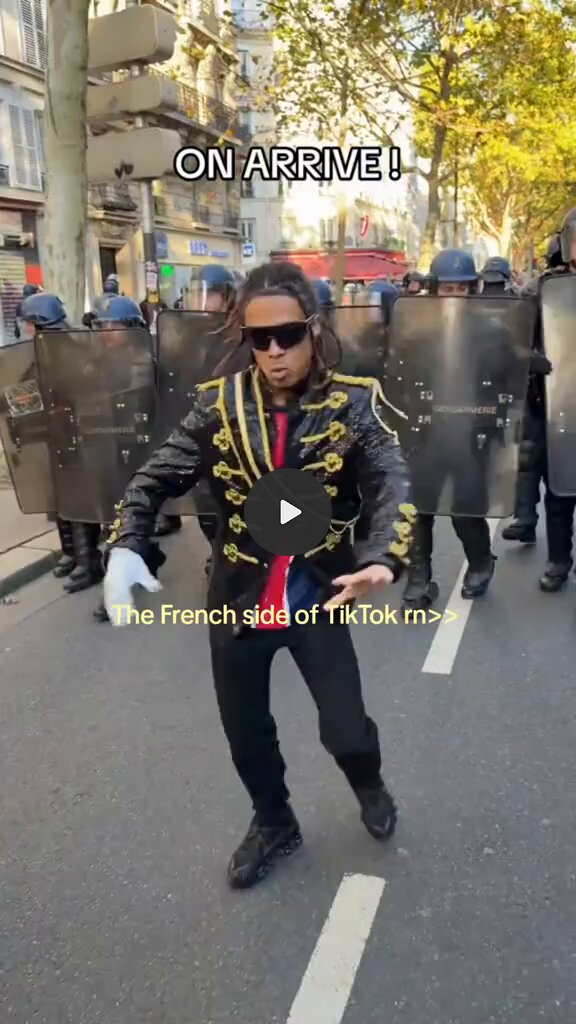
And then there are the speeches. You might have seen that kid Elwan articulately shutting down the rightwing YouTuber. Or you might’ve seen Seydou Ba, speaking at Place de la Republique. The contrast between the skill of these two seventeen-year-old boys (and other viral stars of the protest movement) set against the wooden-tongued mumbling of most politicians or the soundbite-seeking melodrama of the more media-trained ones, is striking.
And it gets to something fundamental. When the state responds with violence to joyful street demonstrations, eloquent rhetoric, and reasonable demands, it doesn’t do so simply because it is cruel. It does so because it has nothing real to say to them, which is why the only thing it does end up saying is shit like “Bismillah, c’est les ténèbres.”
Why Gen Z protests
There are many assumptions made about why young people protest. Pop culture tells you the young protestor is passionate, idealistic, and more than a little naive; that they do not tend to have children or careers that get in the way of activism; that they are on the damn phones too much, radicalized by algorithms. This is all true, but it is incomplete because it assumes the only reasons young people protest have to do with something about them rather than about the circumstances they find themselves in. These stereotypical explanations are all supply-side explanations rather than demand-side ones. You need both.
The biggest demand-side explanation is systemic collapse. Students are canaries in the coal mine. If you’re in a public school or university, your daily relation to the state is more intimate than if you’re forty and working a job, or eighty and on benefits. You see how fast things are falling apart. Think of any social crisis right now – AI automation, racism, austerity, corruption, gun violence, the list goes on — and the classroom is where the rubber hits the road.
In both France and India, the spark for this latest movement is the state’s inability to transition people from childhood to dignified adulthood. In each country, graduating high school seniors go through a process involving a big national exam that sorts them into university or professional training programs. Since each society is structured such that the outcome of this exam essentially determines the lives of most of the students taking it, people commit themselves to studying often at great personal and familial expense. In India, the answers to this big test are routinely leaked and it’s obvious to everyone that rich kids get to cheat their way through. In France, a new Kafkaesque algorithm-driven platform called Parcoursup determines entry into universities, confuses everybody, burdens instructors, and gives students no agency. Last year, a white French girl famously got into a psychology undergrad program by replacing her cover letter on Parcoursup with a recipe for brownies because the platform does not actually care about students.

In each case the unequal, opaque, and visibly deficient system serves to renovate existing structural inequalities — caste discrimination in India and racism against people of color in France. Students in Saint-Denis, on the urban periphery of Paris living in what some scholars have called “postcolonial urban apartheid,” are forced to study in unheated classrooms all winter in schools that are missing teachers and then when the racist Parcoursup algorithm looks at them, it doesn’t take into account that they didn’t have a math teacher for seven months and no air conditioning in the classroom during a heat wave.
France and India are not the only countries that fail their young. In the United States, we put young people in debt peonage and leave them at the mercy of parasitic government contractors like the College Board. And in countries across the world, youth unemployment is surging.
There is a feeling of futurelessness in the air, a sense that a way of life will not be reproduced. Nobody in power really talks about this. They do not know how, and they are not incentivized to learn because the government believes the daily existence of young people is “Bismillah, c’est les tenebres.”
La prise de parole
We are surrounded by people in power who don’t know how to talk to us. Part of it is a skill issue. Put a phone camera in front of the average politician and you’ll see they can hardly cobble a sentence together. If you watch a press conference by Hakeem Jeffries or another normie American politician and take a shot each time he says a cliche like “kitchen table,” “working tirelessly,” or “middle class,” you will be dead of alcohol poisoning.
But another part of it is by design. The less real the conversation, the less people in power have to justify what they do. You see officials who are regularly introduced in tones that hush the crowd suddenly turn smolbean the second someone asks about Gaza. The voice of power in the United States, like in so many parts of the world, is more often hedging, deflecting, and droning on in jargon than it is answering a question. None of these people know how to talk or would have much to say if they did.
Theologian and critical theorist Michel de Certeau famously described the French protest movement of May of 1968 as a “prise de parole,” a “taking of the word.” De Certeau says that unlike the first French Revolution which started with the “prise de la Bastille” (the taking of a prison-castle that symbolized government power) the ‘68 revolution started with people taking the microphone away from government, asserting a right to tell the stories of their own lives rather than have those stories be told to them by a repressive society.
I thought of de Certeau because the caption text overlaid on the first video I viewed of Seydou Ba speaking at Place de la Republique described him as “taking the word” (which is a pretty common expression, I doubt the clipper was de Certeaupilled but who knows). It got me thinking this protest movement globally is a taking of the word, but not in the same way students around the world took it in the Sixties.
Napoleon Bonaparte apparently said, “I found the crown of France in the gutter, and picked it up.” In 1968, the word was enthroned in a metaphorical castle you had to storm. Today, it lies trampled in a metaphorical gutter. Young people have picked it up.
The word is in the gutter for many reasons. The media forms, models, and professionals that used to cherish it are no longer solvent — and the social media platforms haven’t helped. In the age of AI, most of the money in the world is now betting machines have more valuable things to say than humans do, further degrading and demonetizing the word as lived and spoken by real people.
But it isn’t just a materialist story. The word has been thrown away by people in power who think the public is too dumb to listen or be listened to — people who by incompetence, prejudice, and cynicism view the word as window-dressing or instrumental means to an end. Too many are making the choice to trade away the traditions and liberties of the word in return for what they hope will be a ticket to high ground as waters rise around the rest of us.
I was at Columbia University last month speaking at a conference about AI slop and elections. The event went well and afterwards I walked around the campus with a friend, where we saw the grass of the lawn still fenced-off and the gates still closed to the public two years after the suppression of the pro-Palestine protest movement. Sally Rooney, author of Normal People can’t go to the UK anymore or sell books there because she and her collaborators risk arrest for their support of Palestine Action — a real threat, because 3,700 people have already been arrested in the UK for doing things like holding placards in public that say “I oppose genocide, I support Palestine Action.”
After you throw away the word you have nothing real left to say, or at least nothing that makes sense. You can scan QR codes, count dissidents, charge rents, and hit people with your fists like the fascists do, but when asked to say what you really mean, you will be left with nothing but “bismillah c’est les ténèbres.”
Like many memes based off screenshot conversations, I’d imagine some of these are not real conversations with undercover cops, but things created by the teens themselves to represent a larger truth or feeling — in which case they are true in the way a novel is true.
I had previously written “education minister” instead of “Chief Justice” here, corrected now thanks to a commenter.
Once again you have captured a very important nuance of materialist politics and cultural criticism. The analysis of the political class, saying literally nothing to justify unpopular positions and then indignant and righteous when called out on arming and funding genocide was illuminating.
Interesting article! One small correction -in India, it wasn't the minister of education who called the youth cockroaches but rather the Chief Justice.