
Cuck Internet Theory
a confession

There’s no such thing as dead internet theory because what’s actually happening is cuck internet theory.
The problem is not just that bots outnumber human users or inauthentic slop content has flooded feeds, as dead internet theory proposes. What’s happening is weirder and more fundamental: The internet is no longer really for or about us. Rather than the end-user, the human is now just a part of a loop. We haven’t been replaced, duped, scammed, or manipulated — we’ve been co-opted. We’ve been cucked by the computer.
The primary purpose of today’s internet is for various automated processes to talk to one another. The human exists as the setting of a convening, the catalyst of a reaction. When your eye lingers on an AI slop reel, you are allowing two bundles of algorithms that were made for one another to finally meet. It’s a match made, if not in heaven, then in the neural net’s n-dimensional representation of destiny.
The AI generator was built to produce images corresponding to what the algorithms that sculpted its training data recognized and liked in the past. And the algorithm is trained to recommend content similar to what it recommended in the past. They are literally made for each other.

We watch — passively but not entirely without investment, distantly but not without pleasure — and we engage. Every now and then, the human user can be convinced to take out their credit card and buy something. But the lion’s share of our value comes from the RLHF (Reinforced Learning through Human Feedback) we perform for the tech companies without really seeing it as such. We are neither customer (as the companies would lead us to believe) nor product (as tech and advertising critics like Tristan Harris have argued, in a critique of the data-driven type of capitalism that exists today) but a means of production.
On a transactional level, most platforms don’t make money by entertaining you. They make money by showing someone who bought an ad a set of numbers which make them believe they were right to buy that ad. The human user is valuable as the means by which that number is made.
The chain continues. The person who bought the ad makes money by showing those numbers to their boss or client, who makes money by showing their numbers to the investor, who makes money by showing their numbers to another investor, who makes money by arranging elaborate financial instruments and dodging taxes.1

The actual output the platform produces is not whatever human-facing event the number represents — an impression, an engagement — but the representation itself, which is a sellable machine-facing event. Put otherwise, that representation is data. In 2019, Shoshanna Zuboff argued data was “behavioral surplus” which allowed the tech platforms to further optimize and steadily enclose more and more of life within their bounds. In 2026, data is the raw material out of which you build AI.
The most lucrative products in the world today are numbers manufactured by American tech companies and financial institutions. These numbers are processed into training data, pitch decks, valuations, and justifications. Each of these become instruments for extracting more value out of the world of actual people who make things and putting it into the world of people who make slide decks.
They need three things to make those numbers: a computer, another computer, and a human who can make the computers kiss.
Wasn’t it always this way, though?

To some extent, capitalism (or maybe “modernity” is a better word here) has always cucked you. Markets, machines, and bureaucracies talk mostly to and for one another, leaving the customer, the citizen, and the worker behind. But even if we are not seeing a difference in type, we are seeing a difference in format and perhaps degree.
That difference in format and degree is worth marking. Look at it just in terms of internet history over the past two decades. Every minute of those twenty years, people watched videos, chatted, and shared stuff online. Some, but not all, of those engagements resulted in exchange between two humans through the medium of the machine: a creator got a follower or payment, a viewer arrived at an epiphany, or another meme hit the group chat and made everyone smile. But lately (as anyone who makes money from the internet or spends a lot of time there will tell you) this seems to be happening less and less. Some critics, like Derek Thompson, have talked about an internet that’s turning back into a passive broadcast medium. Others have talked about the destruction of media business models and the capture of value by platforms. You could, as Cory Doctorow does, call it enshittification too.
Why do they need a human? Can’t a bot just cuck another bot?
P.E. Moskowitz recently wrote about the end of the “cog era of capitalism,” arguing that while in the past, the powers that be wanted individual people to serve as hard-working, obedient cogs, now “capitalism can function relatively well whether we participate in it or not… capitalism might just prefer that we be dust…”
You could imagine a future where this is true and it’s just bots talking to bots without need of a human in the loop at all… it’s not all that dissimilar from what AI 2027 imagined in the most Doomer of its scenarios. But there’s a few reasons why I think the computers need a human to cuck:
The AI cannot cuck itself because it is not good enough yet, and may never be.
If the robots are to dominate, putting humanity in the cuck chair and teaching us to call it a throne is the best way to keep us in line.
Human interaction may be what keeps things flowing. If it’s just the bots, then they end up doing predictable, stereotyped patterns — they need human involvement and occasional human input for novelty and to get the whole system moving, because otherwise it would just stagnate. There’d also be no opportunity for arbitrage without the unpredictability that human subjectivity brings into the equation.
Why “cuck”?
I used the word “cuck” because it was a good hook to a video. I never planned to write something about this until Charlie Warzel at The Atlantic, one of my favorite journalists, mentioned Cuck Internet Theory in the pages of that eminent magazine which also published W.E.B. DuBois and Ralph Waldo Emerson. In a separate incident, I brought up “cuck internet theory” to a reporter at a major American newspaper, and we had a discussion about whether it was printable — the jury is still out. But if Cuck Internet Theory was going to be mentioned at any of these places, I figured I should establish a record in writing of what I meant.
When I made the original video, I was thinking about “cuck” in the meme sense, as in “every hotel got the cuck chair.” I was not thinking about the full dimensions of the cuck situation or literal sex in any way. At the suggestion of some astute commenters on the original video, I decided to revise Cuck Internet Theory to Cuck Logic Internet Theory (C.L.I.T.) in order to emphasize that I am not thinking about a sex act, but about the logic of the cuck situation which centers around three participants, one of whom is in a stance of ambiguously-passive observership. The cuck situation — and its complicated rapport with agency, where the cuck’s non-involvement is a form of involvement, an active choice to be passive — describes the contemporary online user experience pretty well. We have been conditioned to sit in a cuck chair and call it a throne.
But really, why “cuck”?
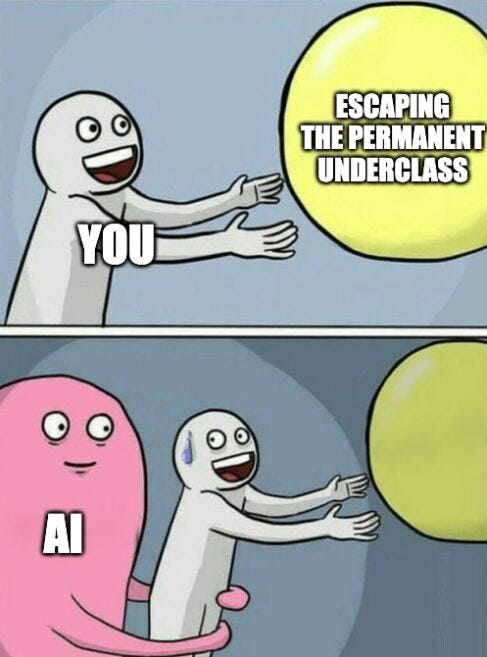
Seeing the situation through the cuck framework helps to more clearly situate the problem. It is not replacement that is going on, but a kind of cyborgization happening according to the terms, timetables, and niche ideological fixations of the world’s richest people. The “replacement” narrative offloads political agency to a scaling law — joblessness, displacement, and suffering become a kind of collateral damage from progress. The policy solutions are necessarily reactive, even palliative.
If we’re being replaced, then the liberal establishment, with its tender technocratic hands, will means-test a new safety net sponsored by Anthropic to catch those helpless fools who fall behind — and the PMCs running that safety net will continue to make six figures in exchange for helping the new aristocrats make eleven. If we’re cucked, as I argue, then the solution is to see the algogarchic2 project not as productive or future-facing at all, but as extractive, a vast magnet pulling money, agency, and meaning out of real life situations. And the question to ask is how to reverse that magnet’s polarity so technology is not taking the world away from you, but giving it to you.
Timothy Wilcox, in the Substack of Katherine Dee (who has also written great stuff on similar topics) imagines the “permanent underclass” that may arrive after AI automates everything as a “burrito courier class” moving stuff between machine systems knit together by platform-based markets. This is not too far from the way things currently are. People have not yet been replaced by AI, but they are being managed by it — surveilled, directed, and paid according to what it decides. We are in the loop, but we do not control the loop. Ask anybody who makes money through an app, including me. The future looks like that. I am a cuck.
This is what Ed Zitron calls the Rot Economy.
algorithmic + oligarchic… is this anything?
*sitting in the comments just watching*
You are doing double duty on helping us comprehend why every interaction on the internet today has become soul-eroding.
Soul is an amorphic term—nevertheless people, in their bones, know what I’m saying.
This is one of your most exciting and entertaining posts ever.